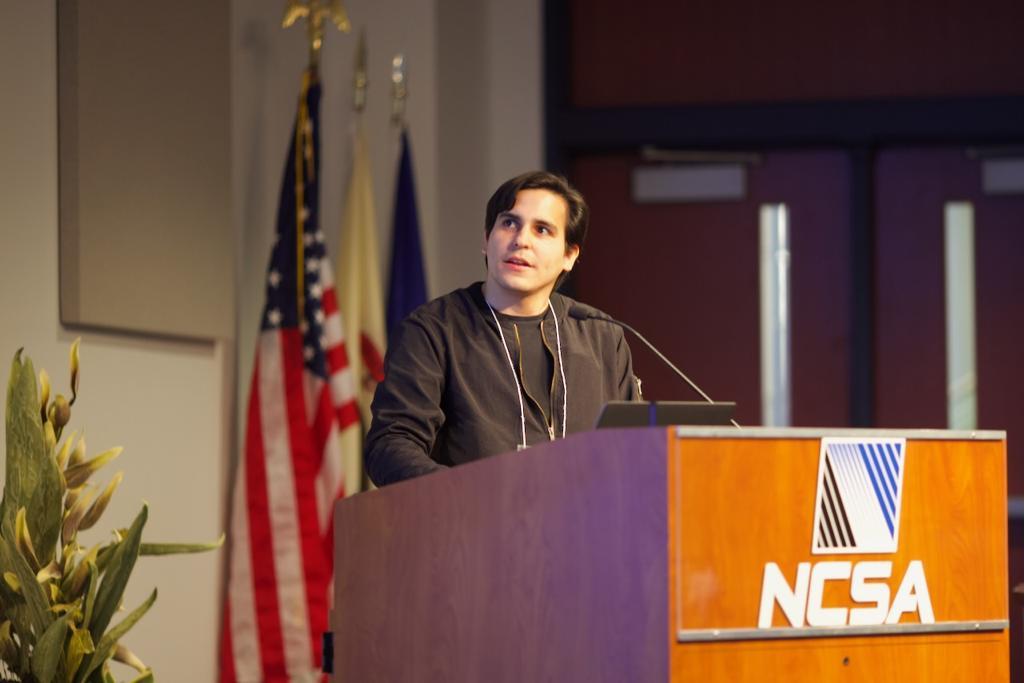
Hello, I'm
Carlos Conde
PhD Candidate in Physics · Gravitational Physics Researcher · Scientific Software Developer
I study neutron stars at the University of Illinois at Urbana‑Champaign, modeling their structure and gravitational signatures with high-accuracy theoretical and computational methods.
About me
Who I am
I'm a PhD candidate in Physics at the University of Illinois at Urbana‑Champaign, working in the Yunes Gravity Theory Research Group. My research focuses on neutron stars, gravitational waves, and black holes — some of the most extreme objects in the universe.
My work lives at the intersection of theoretical physics and scientific computing. I develop high-accuracy models of neutron star structure using the Hartle‑Thorne approximation and contribute to the MUSES collaboration — an open-source framework for the equation of state of dense matter.
Beyond academia, I am passionate about building robust scientific software, data-driven analysis, and making complex physics accessible. I hold a M.Sc. in Astronomy (Laureate honour) from the National University of Colombia and a B.Sc. in Physics, also from Colombia.
6
Peer-reviewed publications
10+
Conference presentations
4+
Years of PhD research
3
Languages spoken
Visual
Simulations
I like to see the physics, not just solve it. I work out the equations myself and then animate what they describe: in Blender when it helps to see things in 3D, in Matplotlib when a plot does the job.
Orbits in Schwarzschild Spacetime
A particle falling around a black hole, a neutron star, or any other round object that is not spinning. In Newton’s gravity the path would close into a fixed ellipse and repeat forever. Here it never quite closes.
Rather than integrate the geodesic equations directly, I write the orbit the way you would write a Kepler orbit. The familiar shape stays, and all the relativity ends up in one place:
(the semi-latus rectum) sets how big the orbit is, (the eccentricity) how stretched, and tracks where the particle is along it. Neither nor ever changes here — but each lap turns slightly more than , so the whole ellipse slowly rotates. That is the precession you are watching.
References
- A. Pound and E. Poisson, Osculating orbits in Schwarzschild spacetime, with an application to extreme mass-ratio inspirals, Phys. Rev. D 77, 044013 (2008). arXiv:0708.3033
- E. Poisson and C. M. Will, Gravity: Newtonian, Post-Newtonian, Relativistic, Cambridge University Press (2014).
Academic
Education
Ph.D. in Physics
CurrentUniversity of Illinois at Urbana-Champaign
Yunes Gravity Theory Research Group
Thesis: “High-order modelling of rotating neutron stars in the Hartle–Thorne framework”
Master of Science in Astronomy
Laureate Honour ThesisNational University of Colombia
National Astronomical Observatory
Thesis: “Gravitational radiation from the inspiral of compact binaries based on a Yukawa-type addition to the Newtonian potential”
Bachelor of Science in Physics
National University of Colombia
National Astronomical Observatory
Thesis: “Motion of S0-2 and S0-102 stars around the supermassive black hole Sgr A*”
Academic
Research
My research sits at the frontier of gravitational physics — exploring the most extreme objects in the universe through theory and computation.
Neutron Stars
I develop highly accurate models of rotating neutron star structure using the Hartle‑Thorne approximation, extended to seventh order in spin. My work connects theoretical models to observable quantities like mass, radius, and moment of inertia.
Gravitational Waves
I study gravitational radiation from compact binary inspirals and explore how alternative gravity theories affect the waveform. My master's thesis examined Yukawa-type modifications to the Newtonian potential in compact binary systems.
Black Holes
My early research explored the orbital dynamics of stars near the supermassive black hole Sgr A* and the properties of black hole solutions in f(R) and Maxwell-dilaton gravity theories.
MUSES Collaboration
I am a core contributor to the Modular Unified Solver of the Equation of State — an open-source cyberinfrastructure project that provides a community-wide framework to study the properties of dense nuclear matter.
High-order multipole moments of rotating neutron stars
Conde-Ocazionez, C., Kuan, H.-J., Noronha-Hostler, J., & Yunes, N.
In preparation
Studying the QCD matter produced in heavy-ion collisions using the MUSES calculation engine
Jahan, J., et al. (MUSES Collaboration)
arXiv preprint
Sensitivity of neutron star observables to microscopic nuclear parameters of realistic equations of state
Cruz-Camacho, N., Conde-Ocazionez, C., Dexheimer, V., Noronha-Hostler, J., & Yunes, N.
Highly-accurate neutron star modeling in the Hartle-Thorne approximation
Conde-Ocazionez, C., Yin, T., Noronha-Hostler, J., & Yunes, N.
Physical Review D 112, 044063
Building neutron stars with the MUSES calculation engine
Reinke Pelicer, M., et al.
Physical Review D 111, 103037
Theoretical and experimental constraints for the equation of state of dense and hot matter
Kumar, R., et al. (MUSES Collaboration)
Living Reviews in Relativity 27, 3
Academic
Talks & Conferences
March 2025
“Accurate neutron star models in the Hartle-Thorne approximation”
APS Global Physics Summit
May 2025
“MUSES Workflow Demonstration”
MUSES Collaboration Meeting — ICASU
Feb 2025
“Research Overview: Accurate neutron star models in the Hartle-Thorne approach”
Seminar, Yunes' Group Meeting — ICASU
Nov 2024
“Accurate neutron star models in the Hartle-Thorne approach”
34th Midwest Relativity Meeting
Apr 2024
“Highly-accurate Neutron Star Solutions in the Hartle-Thorne Approximation”
APS April Meeting
Apr 2023
“Gravitational neutron star observables code within the MUSES collaboration”
AstroFest — National Center for Supercomputing Applications
Aug 2020
“A toy model for gravitational radiation from a particle plunging into a black hole in massive gravity”
14th International Conference on Gravitation, Astrophysics and Cosmology
Get in touch
Contact
Whether you're interested in my research, a potential collaboration, or just want to talk physics — feel free to reach out.
carlosc7@illinois.edu
Academic email
GitLab
carlosc7
Carlos Conde-Ocazionez
ORCID
0000-0002-5393-0565
Google Scholar
Citations & metrics
INSPIRE-HEP
Author profile
Designed & built by Carlos Conde · 2026